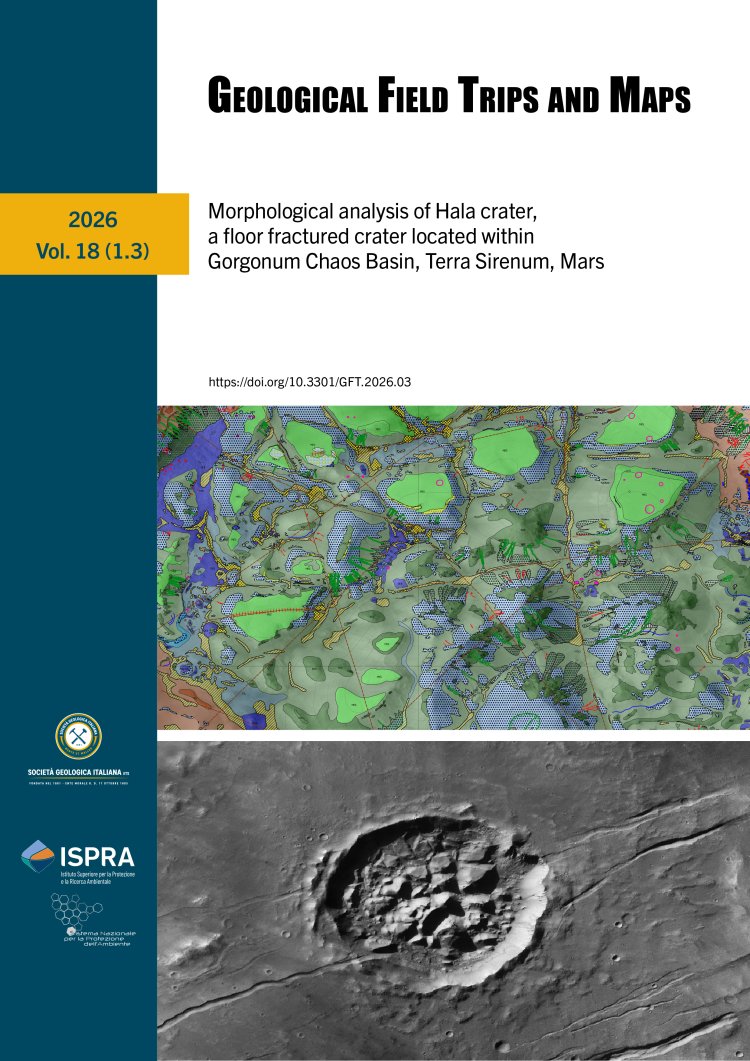
Volume 18 (1.3)/2026
Morphological analysis of Hala crater, a floor fractured crater located within Gorgonum Chaos Basin, Terra Sirenum, Mars
DOI: https://doi.org/10.3301/GFT.2026.03 - Pages: 1-22
Silvia Bertoli1, Matteo Massironi2, Maria Cristina Salvatore3, Carlo Baroni3, Gabriele Cremonese1, Maurizio Pajola1, Ernst Hauber4, Giovanni Munaretto1 & Adriano Tullo1
1INAF, Osservatorio Astronomico di Padova, Padova, Italy.
1Department of Geological Sciences, University of Padova, Padova, Italy.
3Department of Earth Sciences, University of Pisa, Pisa, Italy.
4Institute of Planetary Research, DLR, Berlin, Germany.
Corresponding author e-mail address: silvia.bertoli@inaf.it
1Department of Geological Sciences, University of Padova, Padova, Italy.
3Department of Earth Sciences, University of Pisa, Pisa, Italy.
4Institute of Planetary Research, DLR, Berlin, Germany.
Corresponding author e-mail address: silvia.bertoli@inaf.it
Abstract
Floor-Fractured Craters (FFCs) are complex impact structures characterized by fractures, mesas, and knobs on their floors. They appear extensively on Mars, exhibiting diverse morphologies indicative of multiple geological processes including tectonic, volcanic, glacial, and fluvial mechanisms. This study presents a
high-resolution geomorphological analysis of Hala crater, an 18 km-diameter FFC located within the Gorgonum Chaos Basin, in Terra Sirenum. Utilizing high-resolution imagery from HiRISE, CaSSIS, and topographic data from HRSC-derived DTMs, we compile a geomorphological map at a scale of 1:25,000. Detailed morphometric analyses reveal the crater is anomalously shallow compared to neighbouring structures, implying significant infill processes possibly influenced by magmatic intrusion and localized uplift events. The alignment of fractures within the crater notably correlates with regional tectonic stresses from the Sirenum Fossae system, suggesting substantial structural control. Periglacial landforms further illustrate extensive modification by ice-related processes during the Amazonian.
Overall, our detailed geomorphological mapping highlights a complex interplay of impact-driven, tectonic, volcanic, and periglacial processes that have shaped the crater's interior. This analysis contributes to our understanding of the geological history of FFCs.
Keywords