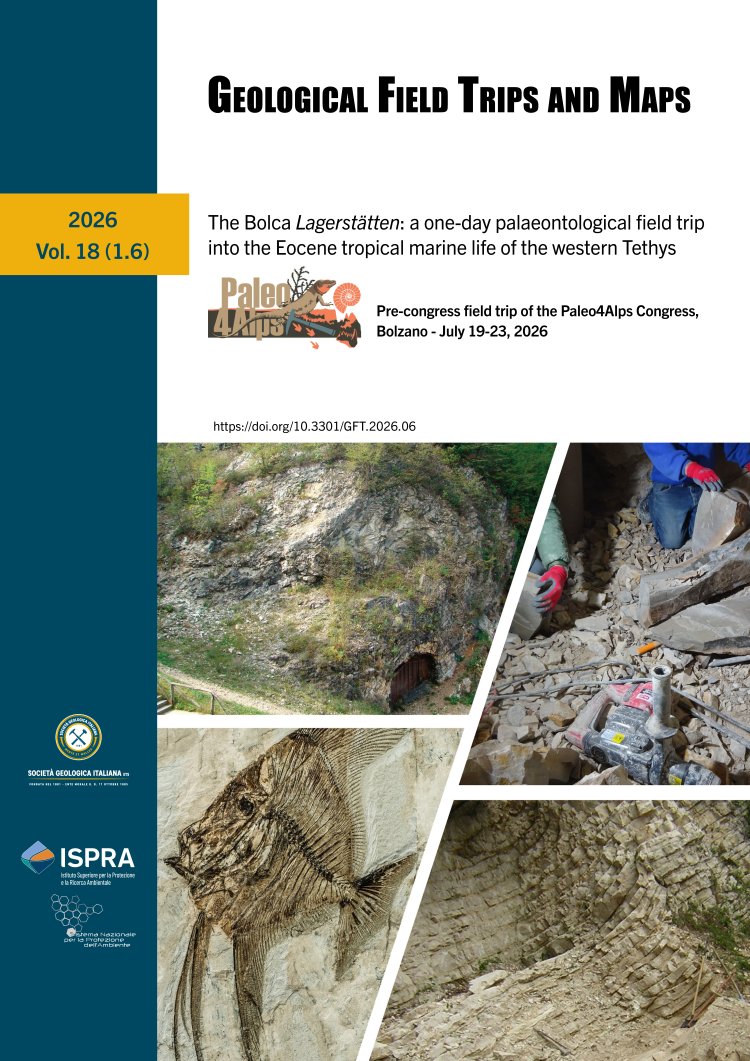
Volume 18 (1.6)/2026
The Bolca Lagerstätten: a one-day palaeontological field trip into the Eocene tropical marine life of the western Tethys
Pre-congress field trip of the Paleo4Alps Congress, Bolzano - July 19-23, 2026
DOI: https://doi.org/https://doi.org/10.3301/GFT.2026.06 - Pages: 1-81
Giorgio Carnevale1, Luca Giusberti2, Stefano Dominici3, Cesare Andrea Papazzoni4, Guido Roghi5, Giuseppe Marramà1, Pietro Calzoni2, Giovanni Serafini4 & Roberto Zorzin6
1Dipartimento di Scienze della Terra, Università di Torino, Via Valperga Caluso, 35, I-10125 Torino, Italy.
2Dipartimento di Geoscienze, Università di Padova, Via Gradenigo, 6, I-35131 Padova, Italy.
3Museo di Storia Naturale, Università di Firenze, Via La Pira, 4, I-50121 Firenze, Italy.
4Dipartimento di Scienze Chimiche e Geologiche, Università di Modena e Reggio Emilia, Via G. Campi, 103, I41125 Modena, Italy.
5Istituto di Geoscienze e Georisorse, CNR, Corso Stati Uniti, 4, I-35127 Padova, Italy.
6 Museo Civico di Storia Naturale di Verona, Lungadige Porta Vittoria, 9, I-37129, Verona, Italy.
Corresponding e-mail address: giorgio.carnevale@unito.it
2Dipartimento di Geoscienze, Università di Padova, Via Gradenigo, 6, I-35131 Padova, Italy.
3Museo di Storia Naturale, Università di Firenze, Via La Pira, 4, I-50121 Firenze, Italy.
4Dipartimento di Scienze Chimiche e Geologiche, Università di Modena e Reggio Emilia, Via G. Campi, 103, I41125 Modena, Italy.
5Istituto di Geoscienze e Georisorse, CNR, Corso Stati Uniti, 4, I-35127 Padova, Italy.
6 Museo Civico di Storia Naturale di Verona, Lungadige Porta Vittoria, 9, I-37129, Verona, Italy.
Corresponding e-mail address: giorgio.carnevale@unito.it
Abstract
The Eocene limestones exposed around the village of Bolca, northern Italy, have provided some of the most complete and wellpreserved marine assemblages of the Cenozoic. The fossils of these deposits, especially the famous fossil fishes, are known for more than four centuries and document tropical marine shallow-water ecosystems of the western Tethys, representing a spectacular snapshot of Eocene marine life. The one-day palaeontological field trip presented herein constitutes a deep immersion into the early Cenozoic marine tropical biodiversity of the western end of the Tethys Ocean. The focus of this field trip is therefore to provide a general overview of the oustanding organism diversity of the two main sites of the Bolca Lagerstätten, Monte Postale and Pesciara, and to show their stratigraphic and palaeoenvironmental setting. The field trip starts with a visit to the Museo Civico di Storia Naturale, Verona, which includes the most important collection of Bolca fossils. Then, the second stop shows the Monte Postale stratigraphic succession, and the third stop illustrates the celebrated Pesciara site, exploited for the collection of spectacular fossils since the 16th century.
Keywords